How UK Families Plan Cultural Days Out and What That Means for Marketers

The summer holidays are one of the best times to understand how families make decisions about days out. With parents and grandparents actively looking for ways to entertain children, it gives us an opportunity to examine where families go and how those decisions are made.
So we surveyed parents and grandparents across the UK who take children to cultural experiences including theatres, museums, heritage attractions and family festivals.
We wanted to understand what they book, what influences their decisions, how far ahead they plan, where they discover things to do and whether emerging behaviours such as using AI to plan trips are beginning to change the picture.
And while every family is different, some interesting patterns emerged.
The one-to-two-week window matters
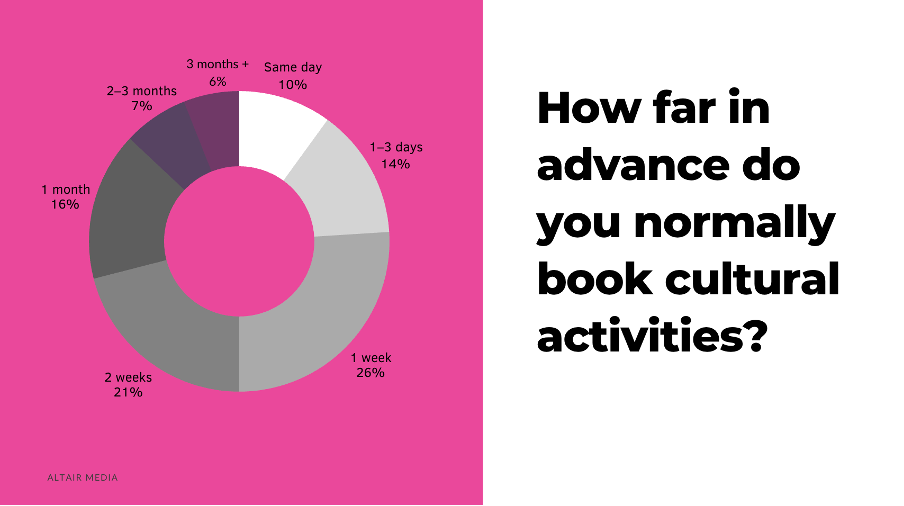
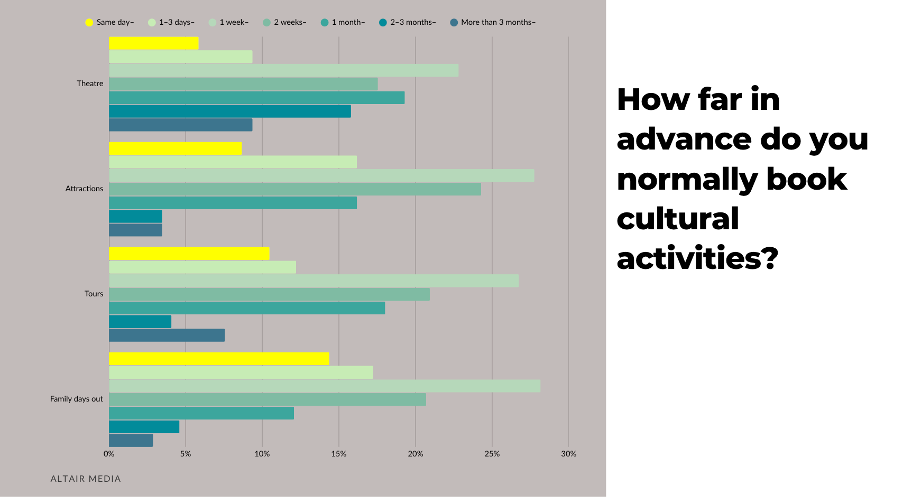
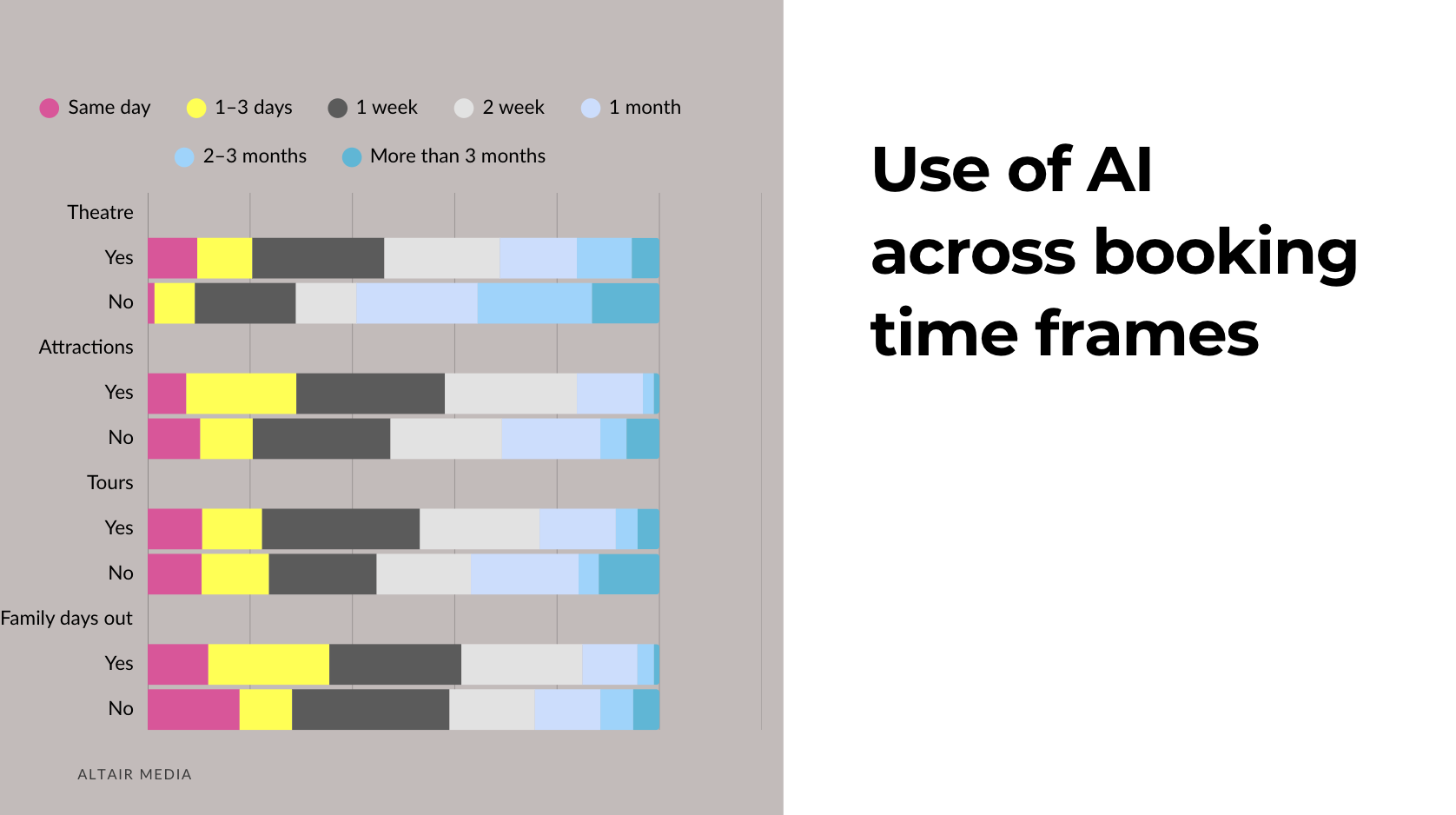
Across theatre, attractions, family days out and tours, one to two weeks emerged as a particularly common booking window.
But the type of experience makes a difference.
Theatre tends to require the most forward planning. Across the survey, 44% of respondents book theatre at least a month in advance, compared with 30% for tours, 23% for attractions and just 20% for general family days out.
The profile of those planning more than a month ahead is also interesting.
Within our sample, forward planners were particularly likely to be aged 30–44, female and in middle-income households earning £20,000–£60,000. This pattern was particularly visible in the Midlands and Northern England.
Among men who plan further ahead, respondents were more evenly split between middle-income and higher-income households earning £60,000–£100,000, with London and Northern England featuring prominently.
Looking at booking time alongside attraction choice adds another dimension. Respondents planning two to three months or more ahead tended to shortlist a wider range of major attractions. The Natural History Museum, Buckingham Palace and London Eye, for example, appeared particularly strongly amongst advance planners.
Major attractions appear throughout the different booking windows, but those planning furthest ahead generally considered a broader selection.
Price and quality win – regardless of when families book
There is considerable consistency when we look at what drives a booking.
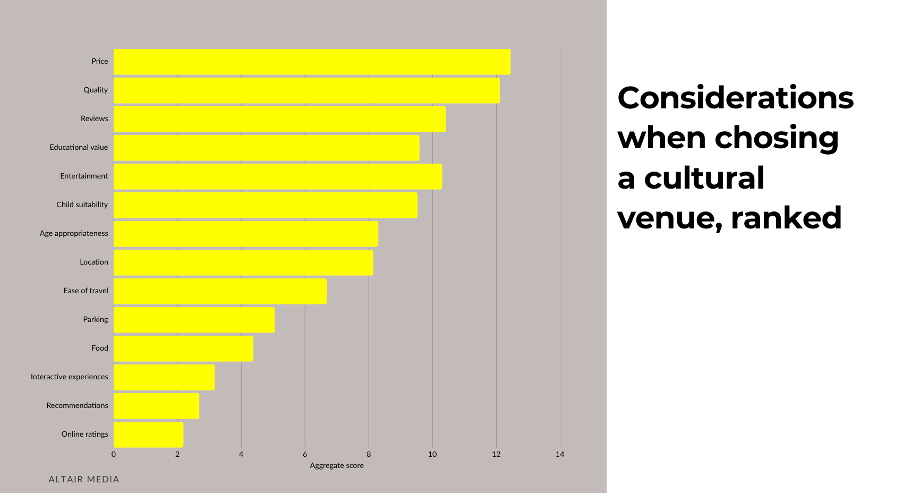
Price and quality are the two strongest considerations across the sample.
Among respondents booking one month or more in advance, both achieve average rankings close to the top of our 14-point importance scale.
Price and quality remain important amongst those booking on the same day or just one to three days beforehand, although these respondents place slightly more emphasis on entertainment and child suitability.
At the other end of the scale, practical factors including food, parking and online ratings consistently rank lower across different booking windows.
So the fundamentals are: families want an experience that feels good quality and represents appropriate value.
Discovery changes as the booking date gets closer
Where the picture becomes particularly interesting for campaign planning is the relationship between when people book and where they discover activities.
Across the full sample, the three leading sources are:
- Friends and family recommendations – 70%
- Google Search – 61%
- Social media – 57%
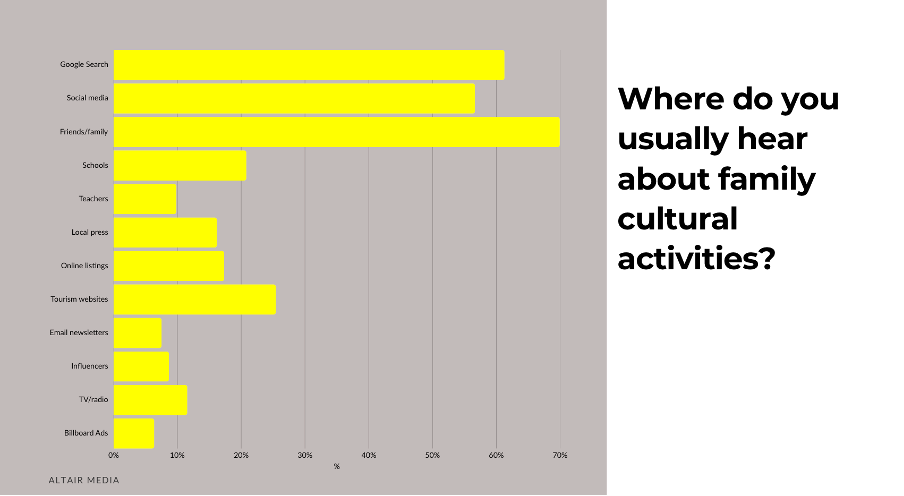
But beneath those headline figures, the channel mix changes according to how far ahead someone is planning.
Those booking two to three months or more in advance use Google and recommendations from friends and family, but are also more likely to consult sources such as schools and tourism websites.
The middle group, booking between around one week and one month ahead, remains heavily reliant on Google Search and personal recommendations.
Amongst the most last-minute planners, friends and family become particularly important, while more formal information sources such as tourism websites and local press feature less prominently.
In other words, the channels families use to make decisions aren’t necessarily static throughout the planning cycle.
Parents and grandparents aren’t quite the same audience
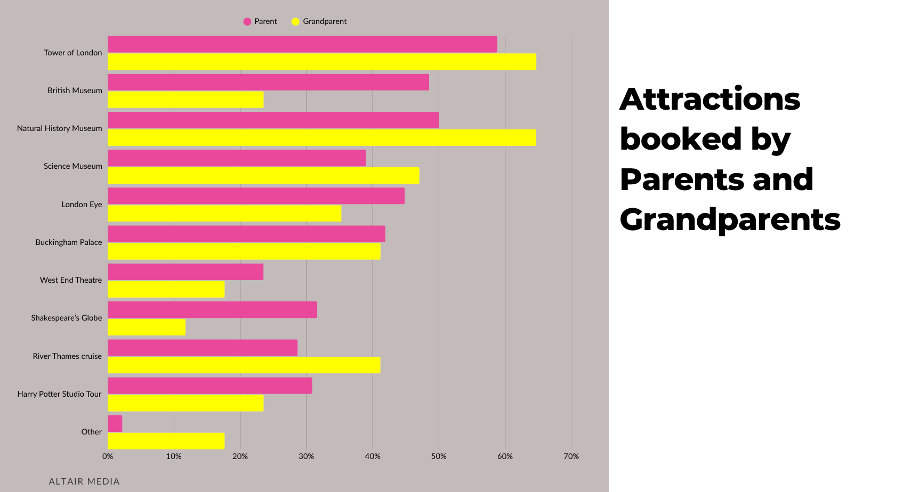
Grandparents are playing an increasingly visible role in childcare, particularly during school holidays, so we wanted to understand whether their behaviour differed from parents.
Parents in our research tend to plan further ahead and consider a wider range of attractions.
Grandparents’ choices are more concentrated around established attractions, with places such as the Natural History Museum, Science Museum and Tower of London featuring prominently.
The differences aren’t enormous, but the data suggests that treating everyone responsible for a child’s day out as one homogeneous “family audience” can obscure differences in how those decisions are made.
Families with younger children behave differently too
The age of the child introduces another layer.
Amongst respondents with children under eight, interactive and participatory experiences feature particularly strongly. Interactive workshops, storytelling and behind-the-scenes experiences all perform well with this group.
Across the research more generally, educational value is important, but it sits behind price, quality, reviews and entertainment as a decision factor.
That distinction is useful: families can value an experience for what children will learn while simultaneously prioritising whether they’ll actually enjoy it.
Geography changes the context more than the fundamentals
We also examined respondents by region.
The Midlands sample broadly mirrors the national audience when it comes to booking behaviour, discovery channels and the factors influencing decisions.
London and South East respondents differ more noticeably in the context of their cultural behaviour, with greater access to cultural experiences and a different mix of local leisure and destination decisions.
Yet some behaviours remain remarkably consistent across regions.
Theatre is generally booked further ahead than other types of family outing. Price and quality remain leading decision factors. Recommendations, Google and social media remain important discovery sources. And interactive, storytelling and behind-the-scenes experiences have appeal across geographic groups.
The regional picture therefore contains differences, but perhaps just as interestingly, it highlights how many of the fundamentals of family decision-making remain consistent.
And then there’s AI
No piece of audience research in 2026 feels complete without asking about AI.
We asked respondents whether they had ever used tools such as ChatGPT or Gemini to help plan trips.
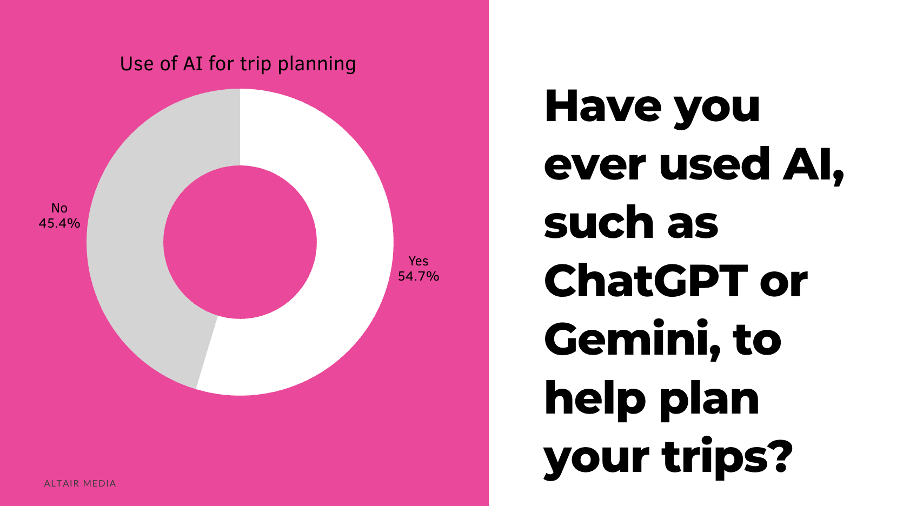
Those who had used AI broadly shared the same fundamental motivations as the rest of the audience: price and quality remained highly important.
But there were some intriguing differences.
AI trip planners were more likely to include a broader range of experiences within their consideration and were slightly more likely to recommend a cultural attraction to other people.
They also stood out when looking at attraction consideration: in our sample, 40% of AI trip planners included Shakespeare’s Globe on their London shortlist, compared with 29% across the overall audience.
Age plays a role here too. Under-45 respondents were more likely to report using AI for trip planning than those aged 45 and over, while social media also featured more prominently as a discovery channel amongst the younger group.
This is still an emerging behaviour, but it is one worth watching.
Traditional search asks people to know enough about what they want to type it into a search box. Generative AI allows someone to start with the problem instead: “What can I do in London with a seven-year-old who likes history?”
That creates a subtly different route to discovery.
Family audiences aren’t one audience
Perhaps the clearest conclusion from the research is that there isn’t a single “family audience”.
A parent planning three months ahead behaves differently from somebody looking for something to do this weekend. A grandparent may have a different consideration set from a parent. Families with younger children place particular emphasis on interactive experiences. London families operate within a different leisure environment from families travelling from the Midlands or North. And an emerging group is now asking AI to help decide where to go.
Yet underneath those differences are some remarkably consistent fundamentals.
Price matters. Quality matters. Personal recommendations matter. And families want experiences their children will genuinely enjoy.
For cultural marketers, understanding both sides of that equation, the behaviours that remain constant and those that change according to audience and booking window, gives us a much richer basis for deciding who to reach, where to reach them and, crucially, when.