Beyond the Website: What Happens When Customers Stop Being the Customer?
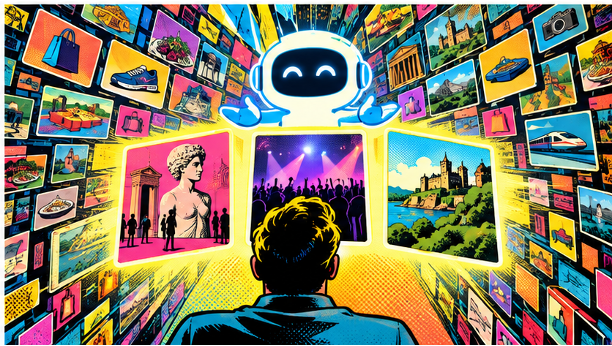
For the past few years at Altair we’ve been talking about a future where people stop navigating the internet and start asking their AI assistants to navigate it for them. That future is arriving rapidly and the opportunities could be extraordinary.
Think about how we use the internet today. We search, click, browse, compare, filter and eventually buy. Websites and apps sit at the centre of that experience.
Now imagine 2030.
You tell your AI assistant: “Find something interesting for the family this weekend, under £150, ideally somewhere we’ve never been.”
Rather than presenting ten websites, it recommends an exhibition, checks availability, suggests a nearby restaurant and books everything with your approval and you haven’t visited a single website.
From browsing to delegating
A recent article in The Verge highlights how a tiny food-delivery startup, Bites, is challenging the established model of DoorDash.
By enabling people to order through ChatGPT, Bites potentially removes expensive intermediaries, reduces costs and creates a more direct relationship between restaurants and customers.
And the implications obviously extend far beyond your takeaway.
As we have talked about before in our Horizons series, WhatsApp is already evolving from a messaging platform into a place where businesses can recommend products, answer questions and facilitate purchases.
For a museum, imagine someone messaging: “We’re visiting London with two teenagers who love science. What would you recommend?” An AI could suggest an exhibition, explain why it’s relevant and arrange tickets.
For B2B SaaS, imagine a marketing director asking their assistant to identify software that integrates with Salesforce, meets specific security requirements and costs less than £20,000 annually. The assistant could shortlist suppliers, compare functionality and arrange demonstrations.
As we know with LLMs already, the buying journey becomes a conversation, not a series of clicks.
The billion-pound question: who controls discovery?
Amazon has taken legal action against Perplexity over AI shopping agents, blocked Meta’s Muse agent and restricted product information potentially useful to Google’s shopping tools. There are of course genuine questions about security, access and customer consent. But there’s also an enormous commercial considerations for Amazon here.
Digital platforms make money from controlling discovery: sponsored listings, advertising, recommendations, upselling and cross-selling, but what happens when AI bypasses all of that?
What happens to impulse purchases? To discovering an unexpected product? To the additional ticket, membership upgrade or premium software package?
And ultimately, what happens to profitability?
Serendipity doesn’t have to disappear
This is the coolest bit, AI could make discovery more relevant, not less surprising.
A cultural organisation might introduce someone interested in contemporary art to an experimental theatre production they’d never considered. A heritage attraction could recommend a special event based on someone’s interests rather than their previous purchases.
A SaaS provider could identify an additional product that genuinely solves a customer’s emerging business problem.
This all means that cross-selling becomes less about interrupting the customer and more about understanding them. This all means businesses can run with fewer intermediaries, they could potentially retain more margin, invest more in the customer experience or just stop charging so much for everything.
Websites aren’t dead. Their purpose is changing.
We’ll still need websites. They’ll remain important for inspiration, storytelling, reassurance, accessibility and brand experiences, but increasingly, they’ll also need to become reliable sources of information that AI assistants can understand and act upon.
That means structured data, accessible content, connected systems, transparent pricing and the ability for authorised assistants to check availability or complete transactions.
For culture and heritage organisations, it means making collections, performances, experiences and membership propositions discoverable beyond their own websites.
For B2B SaaS, it means ensuring AI can understand your capabilities, integrations, differentiation and commercial value.
For marketers, it means thinking beyond rankings, impressions and website visits towards influence, recommendation and completed outcomes.
The opportunity is bigger than the technology
We don’t know exactly how quickly people will embrace this new behaviour. Trust, privacy and commercial interests will shape the journey, but we do seem to be heading in the direction of AI assistants and an internet that could be fundamentally different or two tiered.
At Altair, we’ve been exploring these possibilities for quite a while. What’s exciting now is seeing them move from speculation into real-world applications.
The winners in all of this will be the organisations that are easiest to understand, most valuable to recommend and simplest to do business with. They will be the ones that realise the human facing website will play a very different role compared to today and could potentially become optional.